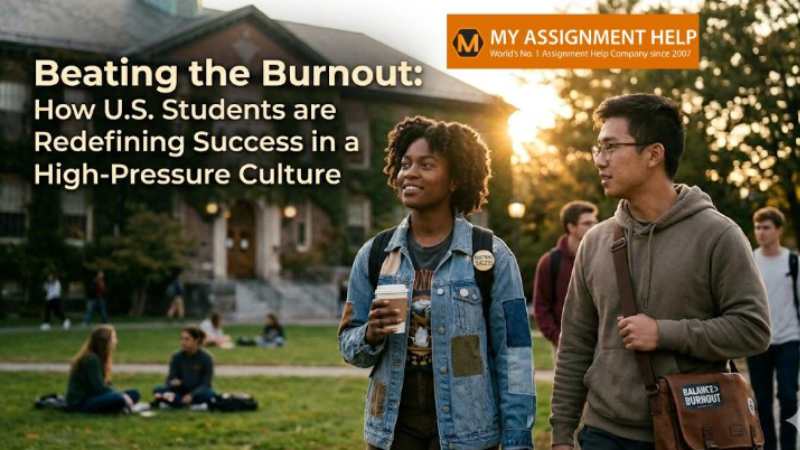
The American academic landscape has long been defined by a “more is more” philosophy. For high school students eyeing Tier-1 universities and undergraduates navigating rigorous degree paths, the pressure to maintain a perfect GPA, hold leadership positions in multiple clubs, and secure prestigious internships has created a pressure-cooker environment. Recent data suggests that academic stress is a leading factor in student burnout, characterized by chronic exhaustion, cynicism, and a plummeting sense of accomplishment.
However, a shift is occurring. Across campuses from the Ivy League to state colleges, students are no longer accepting burnout as a rite of passage. Instead, they are adopting sophisticated frameworks to protect their mental well-being while maintaining high performance.
The Anatomy of Academic Burnout
Burnout isn’t just “feeling tired”; it is a physiological and psychological response to prolonged stress. When the demands placed on a student exceed their resources—time, energy, and support—the nervous system enters a state of persistent “fight or flight.” This leads to cognitive fatigue, making it harder to retain information, which in turn necessitates more hours of study, creating a vicious cycle.
In the United States, this is often exacerbated by the “comparative trap” fueled by social media. Seeing peers post about their summer internships or Ivy League acceptances creates a perceived need for constant movement. This “hustle culture” suggests that any moment not spent being productive is a moment wasted. To break this cycle, students are moving toward “strategic output”—a method of working that prioritizes the quality of cognitive effort over the quantity of hours logged. When specialized technical tasks become a bottleneck for this output, many students look for targeted assistance or ask experts to do my coding homework to maintain their mental equilibrium.
1. The Shift to Deep Work over “Busy Work”
One of the most effective ways students are reclaiming their time is through the adoption of the Deep Work philosophy. In an era of constant notifications, the ability to focus without distraction on a cognitively demanding task is a superpower.
Deep Work is defined as activities performed in a state of distraction-free concentration that push your cognitive capabilities to their limit. For a student, this means moving away from “shallow work”—tasks like checking emails or organizing folders—and into high-value study.
How to Implement Deep Work:
- The 90-Minute Rule: Research suggests the human brain can only maintain peak focus for about 90 to 120 minutes. Students are now scheduling isolated “sprints.”
- Eliminating Context Switching: Every time you check a text, your brain takes an average of 23 minutes to return to full focus. Putting phones in “Do Not Disturb” mode eliminates this “switching cost.”
- Environment Design: Creating a dedicated space used only for deep study helps the brain enter a flow state more quickly.
2. Prioritization via the Eisenhower Matrix
High-pressure environments often feel overwhelming because every task feels urgent. Students are increasingly using the Eisenhower Matrix to categorize their responsibilities. By utilizing academic help in Canada from Myassignmenthelp , students can better manage their Quadrant 1 crises and focus on long-term growth.
By categorizing tasks into these four quadrants, students can visualize where their energy is going:
- Quadrant 1 (Urgent and Important): Deadlines and crises that must be handled immediately.
- Quadrant 2 (Not Urgent but Important): The “Goldilocks Zone.” This includes long-term studying, exercise, and relationship building. The more time spent here, the fewer tasks “leak” into Quadrant 1.
- Quadrant 3 (Urgent but Not Important): Distractions that feel like work but don’t move the needle—like unnecessary group chat notifications.
- Quadrant 4 (Not Urgent and Not Important): Mindless scrolling that often leaves students feeling more drained than before.
3. Embracing the Pomodoro Technique and Micro-Resting
The human brain is not designed for marathon study sessions. To combat cognitive decay, the Pomodoro Technique has become a staple in American dorm rooms. This involves working for 25 minutes followed by a 5-minute break.
The science behind this involves the “Default Mode Network” (DMN). When we stop focused concentration, the DMN activates, allowing the brain to consolidate memories and make creative connections. This is why “aha!” moments often happen during a walk rather than during forced concentration. Micro-resting prevents the “brain fog” that characterizes the early stages of burnout.
4. Digital Literacy and AI as a Co-Pilot
A significant portion of modern student stress stems from the sheer volume of information management. This is where Agentic Literacy comes in—the ability to use AI tools not just as search engines, but as cognitive partners.
Ethical AI integration allows students to:
- Synthesize Research: Using AI to summarize long-form research, allowing the student to decide which sources deserve a “Deep Work” deep dive.
- Active Recall Training: Generating practice exam questions based on lecture notes.
- Administrative Offloading: Automating citation organization, freeing up mental bandwidth for high-level synthesis.
5. Redefining Resilience through Community
For decades, the “American Dream” in education was framed as a solo trek. But the new generation of students is realizing that isolation is a catalyst for burnout. Study groups are evolving into “wellness cohorts” where students share resources and emotional support. Acknowledging that “it’s okay not to be okay” has lowered the barrier for seeking help, whether from peer mentors or professional academic services.
Frequently Asked Questions
Q.1 How can I tell the difference between normal stress and actual academic burnout?
Stress is generally characterized by “over-engagement”—feeling frantic or hyper-reactive. Burnout, conversely, is characterized by “disengagement.” If you feel emotionally blunt, cynical about your education, or feel that no matter how much you study, you aren’t making progress, you are likely experiencing burnout rather than simple stress.
Q.2 Does the Pomodoro Technique work for long-form essay writing?
While many find it helpful, some students prefer “Flowtime” for creative tasks. In Flowtime, you work as long as you are focused (sometimes 50–90 minutes) and take a break only when your focus naturally dips. The key is the guaranteed rest, not necessarily the 25-minute timer.
Q.3 Is using AI for research considered “cheating” in U.S. universities?
Ethical AI use is about augmentation, not replacement. Using AI to help organize your thoughts, explain a complex concept in simpler terms, or format a bibliography is increasingly seen as a vital digital skill. However, submitting AI-generated prose as your own work violates academic integrity. Always check your specific university’s AI policy.
Q.4 How do I handle “Quadrant 1” crises if I’m already burnt out?
If you are in a state of acute burnout, you must practice “Radical Prioritization.” Identify the one task with the highest consequence of failure and focus solely on that. Delegate or delay everything else. Seeking an extension through academic support services is a valid strategy when your health is at risk.
Q.5 What are the best “Quadrant 2” activities for long-term success?
The most impactful activities are those that build “future capacity.” This includes regular sleep hygiene, physical activity, networking with professors during office hours, and deep-dive learning into topics you are passionate about, rather than just what is on the test.
The Long-Term View: From Academic Survival to Career Readiness
The skills required to beat burnout in university—time management, setting boundaries, and leveraging technology—are the exact same skills required in the modern “skills-first” economy. Employers are increasingly looking for graduates who can manage their energy as effectively as their output. By prioritizing mental health and efficiency today, U.S. students are not just surviving their exams; they are building a sustainable foundation for their future careers.
About the Author: Drake Miller
I am a dedicated blog author associated with Myassignmenthelp.com, known for crafting insightful and student-focused content. His writing covers academic challenges, study strategies, and assignment guidance, helping learners navigate complex topics with ease. With a clear and engaging style, Drake consistently delivers practical advice that supports students in achieving better academic performance and managing their workload effectively.