
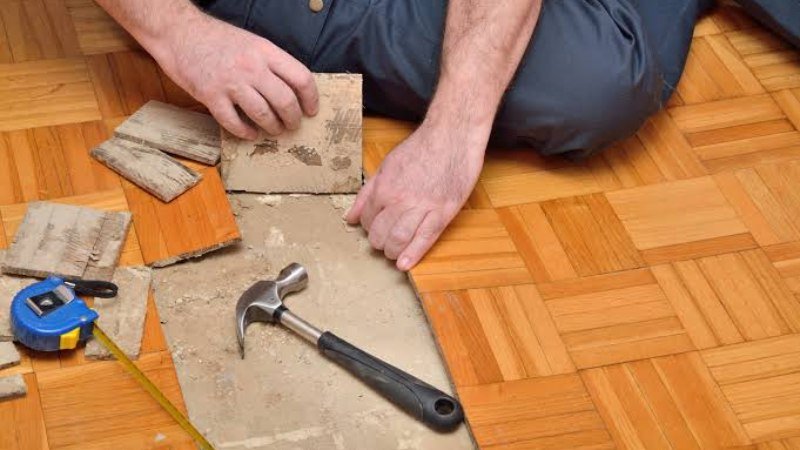
A kitchen renovation comes in close to budget until the contractor’s final walkthrough, when someone notices the hallway floor. Scratches running the length of the traffic route. A stain where a bucket sat. Two gouges near the doorway that catch the light.
Refinishing that floor was not in the estimate. It is now, and it will cost more than covering it would have.
Surface protection is one of the few renovation expenses that reliably pays for itself, and it is also one of the first things cut when a budget gets tight. The reason is timing: protection is paid for at the start, against damage that has not happened yet.
The Arithmetic Nobody Runs
Refinishing a hardwood floor, regrinding and resealing polished concrete, or replacing terrazzo all price per square foot, and all of them price higher than temporary protection does over the same area.
The labor is the larger share. Refinishing means clearing the space, containing dust, sanding, and multiple coats with cure time between them. For a household, it also means not using the room for several days after the project was supposed to be finished.
Replacement is worse. Matching an existing floor is often impossible, which turns a repair into a whole-room job.
Against that, protection is a one-time material cost plus a few hours of installation. The ratio holds across most projects, and it improves the more expensive the floor underneath is.
Grit Does More Damage Than Tools
People picture a dropped hammer. The more common cause of loss is finer than that.
Construction generates dust constantly, and dust on a hard floor is abrasive. Every trip across it grinds particles into the finish. After a few weeks of foot traffic on an unprotected surface, the wear pattern follows exactly where people walked, and it is visible in raking light even where no single incident occurred.
Spills are the second source. Adhesives, solvents, paint, joint compound, and cleaning chemicals all interact with floor finishes differently, and some of the reactions are immediate and permanent.
Point loads are the third. Scaffold feet, appliance dollies, and tool chests concentrate weight over small areas and leave indentations in softer surfaces.
None of these are dramatic. All of them accumulate.
Cheap Coverings Fail In Predictable Ways
Rosin paper, cardboard, and plastic sheeting are the default because they cost almost nothing.
They also move. Anything laid loose on a floor shifts under traffic, and once it shifts, the seams open. Grit migrates through the gap and gets ground into the floor by the covering itself, which is worse than no covering because it holds the abrasive in contact with the surface.
Taping the seams introduces a different problem, since tape adhesive on a finished floor can lift or discolor the finish when removed weeks later.
Plastic sheeting adds a moisture issue. It traps vapor against the floor, which matters on concrete that is still releasing moisture and on wood that responds to humidity changes.
Cardboard absorbs spills and holds them against the surface rather than letting them be wiped up.
Adhered Systems Solve The Movement Problem
The alternative is a covering that bonds to the floor rather than resting on it. Systems of this type use a water-based liquid base coat rolled onto the surface, with a coated mat pressed into it while wet, forming a single layer that adheres and later peels away.
Because the layer is bonded, it does not slide, and debris cannot work its way underneath. Overlaps between rows can be sealed with the same base coat, which makes the assembly effectively water-resistant across its whole area.
Other practical features matter on an active job. A bonded system takes framing built over the top of it without being disturbed. It is slip resistant in wet and dry conditions, which is not true of plastic sheeting. It accepts pencil and chalk layout marks without those marks reaching the floor.
A commercial floor protection system of this kind is typically specified for concrete, including sealed and polished finishes, and for terrazzo. That is the core of its application, and it is also the limit of it.
The Compatibility List Decides Everything
This is the part homeowners need to check first, because the exclusions are extensive and absolute.
Systems of this type are generally unsuitable for unsealed hardwood, white oak specifically, most linoleums and vinyls, carpet and other fibrous materials, rubber flooring, painted surfaces, pavers, unfilled travertine, and acid-washed concrete. The issue is usually the base coat’s alkalinity reacting with the surface, or the bond becoming permanent.
There is also a cure requirement on concrete. Fresh concrete has a high surface pH, and protection typically cannot go down until roughly fourteen days after placement, subject to slab thickness and conditions. The same applies to any sealer, densifier, grout, or epoxy already on the floor: those need to be fully cured to their own manufacturer’s specification, not merely dry to the touch.
For a typical residential renovation with hardwood or vinyl floors, this rules the approach out, and a different protection method is needed. For a project over concrete or terrazzo, it fits well.
A spot test on the actual substrate is the standard precaution and takes a day.
Coverage Estimates Run Optimistic
Material quantity is where budgets get missed.
The base coat needs a consistent wet thickness, and yield depends heavily on the surface. On a flat sealed floor, a gallon covers a meaningful area. On raw concrete, or anywhere with grout lines or surface undulation, that yield drops substantially, because the rough surface absorbs more.
Ordering against the best-case figure means running short partway through and paying for a second delivery.
Application conditions add constraints. Surface temperature needs to sit within a working range, relative humidity matters, and the material cannot go down outdoors if rain is likely within a day.
After installation, the area needs a few hours clear before foot traffic, and machinery typically waits until the following day.
Removal Is Where Money Is Lost
A bonded system peels off in strips, lifted at an angle, and goes out with general waste.
Three things make that harder than it should be. Prolonged UV exposure degrades the peelability of the base coat, so an area left uncovered to sunlight for months removes badly. Cold does the same, with removal below roughly freezing becoming noticeably more difficult. Standing water can soften the mat and break the bond, though it generally recovers once dried.
Any base coat that was smeared or pressed rather than allowed to form a film will not peel at all, and that is an installation error made at the start and discovered at the end.
What To Price Before You Commit
What the floor actually is, checked against the product’s exclusion list rather than assumed.
How long the protection needs to stay down, and whether UV or freezing conditions will be part of that period.
The real material quantity for the surface texture involved, not the flat-floor figure.
Protection is a known cost at the start of a project. Refinishing is an unknown one at the end, negotiated after the damage is already there.